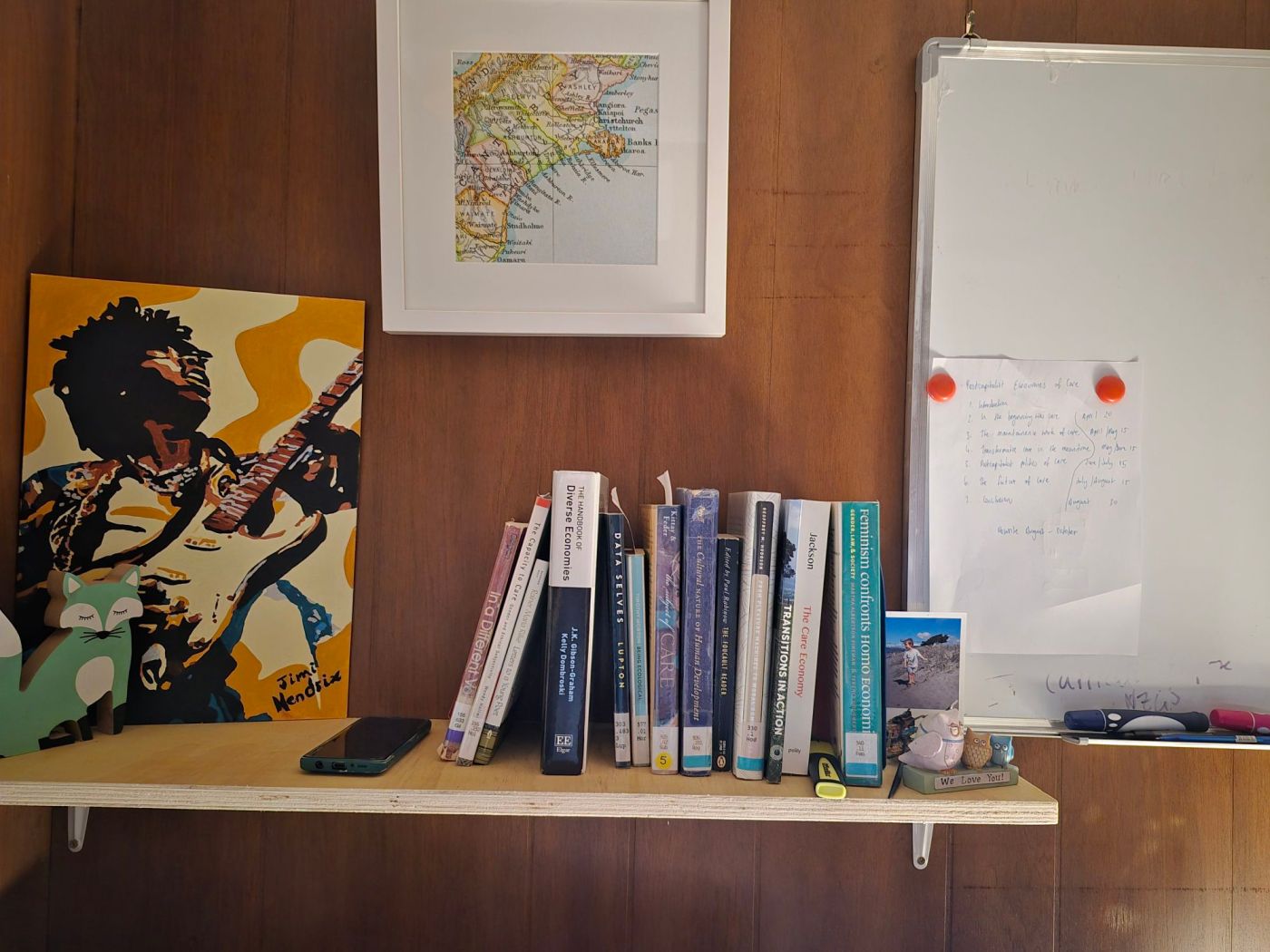
Recently, one of my students asked me this question, as they were overwhelmed with lots of great ideas and recommendations. A few days later, when I commented offhand at home that I needed to get through about 20 books this week in order to write a 1000 word section in my own book, my husband asked the same thing: How do you decide what you need to read? I love finding out about how other people organise the nitty-gritty of their academic life, but I couldn’t find much on this in my usual sources. So I’m jumping in! I can only speak from my own experience and I’m constantly tweaking it. But here is how I do it, within the particular constraints of 2026: a heavy load of supervision and research grants (lots of reading other people’s drafts, and meetings), an average teaching load that includes community engagement time, and three kids at home including one of an age that needs more attention.
First, I’ll point out that for me there are two kinds of reading lists. One is the reading list of ‘things I’ve always wanted to read’, and the other is the reading list of ‘things I need to read in order to write the thing I’m working on right now’. When I say lists, I don’t actually keep a written list, it’s scattered in different places as you will see below. But I keep these categories alive in my head. To me, it’s important to keep those categories separate. (FYI, I do ask my students to bring me a spreadsheet of what they plan to read and help them prioritise. But I’m not that organised myself). Let’s start with the reading list of ‘things I’ve always wanted to read’, as we can dispense with that quite quickly, then move on to the reading-while-writing mode.
Things I’ve always wanted to read – deciding what is included and when you read it
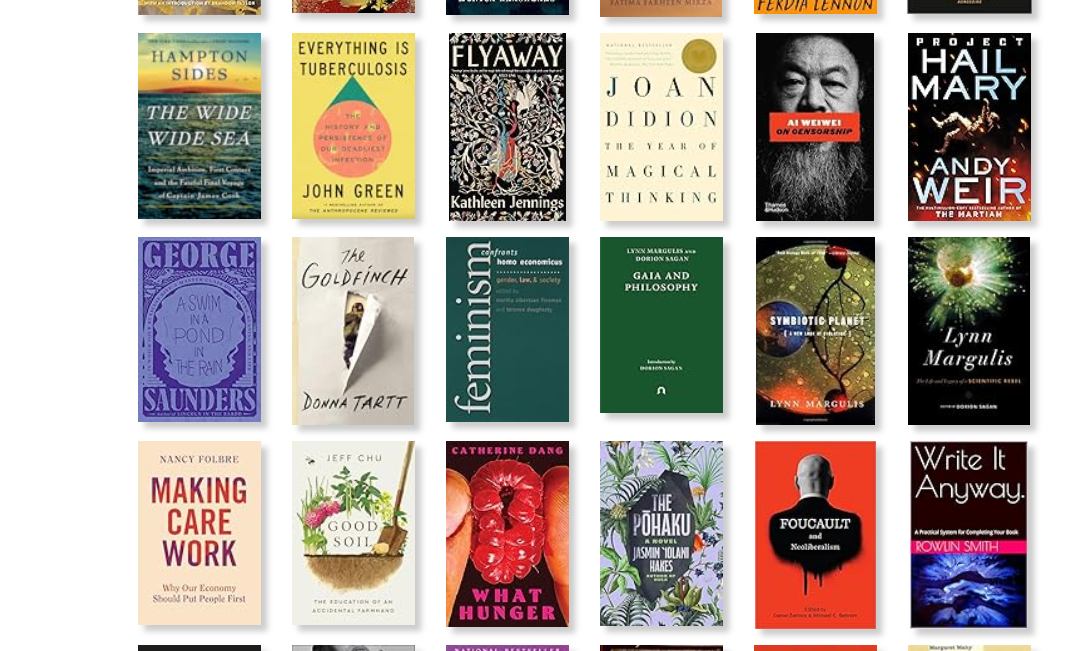
For me, this is quite simple. I use Goodreads. When I hear about a book or see a book I want to read, I search it up on Goodreads or scan the barcode (includes a phone app) and add it to my ‘want to read’ list. This is very long, like 700+ books, but some of them are fiction and some of them I no longer want to read. I then scroll through the app when I am thinking about reading at another time, for example, I remembered a book vaguely, or someone asks me about a book. If I know there are a few other people wanting to read the same book, I might start a reading group, or suggest it to a reading group I already belong to. Once, my daughter used this list to select me a birthday present!
The main way these books get read is: a) reading groups, b) I see them as an audiobook on Libby or Spotify and listen to them while walking OR c) they shift off this list on to the next list and suddenly become more urgent. Sometimes I buy them, sometimes I download them from the university library into my dropbox called “books” and then those ones I read while I’m waiting for kids to do things or travelling by plane or train.
What about articles? If I come across an article I want to read, I kind of just do — I can read quite fast, they aren’t very long. If I don’t have time to read it right away, I print it. I have a plastic sleeve of articles printed — around 4 or 5 at a time as well as student or editorial work that needs my attention. I read these without any electronics on, with a highlighter in hand. When I get to the end of the article, I either open my bullet journal, my writing notebook, or I turn it over and on the back page I write and quickly answer the following questions:
- What is the author trying to do?
- How are they doing it?
- Hows does this relate to other things I’m reading?
- What do I think?
I then usually file these under a project I’m working on in my filing drawer. I’ll get them out or my notes when I’m working on a piece of writing that engages with them, and spread them out over my desk. Or I might not. In sum, this category is basically decided like this: I feel interested in reading it, I feel like reading it, I read it or some of it, and I might feel like writing notes — which is a good idea for future Kelly. Or I might not. No pressure.
Things I need to read in order to write the thing I’m working on right now – deciding what is included and when to read it
Figuring out what to read and then reading it for the thing I’m working on right now is a completely different process for me. It’s work. I’ve got to get on to it. I need to be professional, but I don’t need to be a perfectionist. It doesn’t have to be fun, but it might be. Here’s how I approach it.
Firstly, I open up the thing I’m working on. This might mean writing up the chapter outline of a new book on my whiteboard or in my writing journal. It might mean opening up a word file with the title of an article and the list of co-authors, pasting in the abstract I submitted to somewhere and the author guidelines, or writing a tiny text to get me started on the argument. I write up an initial structure. I quite like a simple, symmetrical structure of around 5 sections of equal length for a chapter or an article. If it’s reporting on research, it might use a boring scientific report type structure. Whatever, I just get it down. I might be opening up a file that my co-author has sent me, that is actually a first draft but I need to do some work on the literature and theory sections. Once I’ve opened that up, I have a quick read through — say 5-10 minutes — then I identify what I already know and what I might need to do more reading on.
For example, recently I needed to write a section on care and subjectivity. I already had the argument in my head but it was primarily based on the work I had done writing about commoner subjectivities and how they were made and remade in the context of doing commoning work. So I need to learn more about how people writing on care wrote about subjectivity and what was going on in that world.
Last year, I had a full draft from my co-author about circular economies and the interviews we had done with some community organisations and businesses. I read through and identified that we might make an argument around surplus and necessity decisions in terms of reinvesting in circular economies. My co-author had read the circular economies literature, but I took up the task of reading deeper into the literature on surplus and necessity in the field of diverse economies. So how do I then decide what to read?
1. I begin with people I know writing in that area. That’s always my go to — mainly because I have a sense of who they are as a person and who they are in conversation with. By “people I know”, I don’t mean we are mates and hang out (although sometimes that is true). I mean people who I have read before and interacted with either by using their work or by interacting with them through conferences, review processes, contributing to shared volumes or special issues. I look up what they have done on this topic, using their Google Scholar profile or their university profile. If I have access to it, I open up the articles or books and read a little bit to see where it is going. I look at who they are in conversation with/citing then I might look those people up too. I then look these up on our university library site, which has a function to ‘save to a project’. I save lots of things to the project I’m working on, currently ‘Postcapitalist Economies of Care’, anything that I might want to come back to.
If it seems like something I might read, I download the pdf (for articles) and file it in a folder called ‘reading’ under the folder for the thing I’m working on (in this case ‘Postcapitalist economies of care’ under the folder ‘Work in Progress’). If it’s a book, and I can download it, I save it under ‘books’ in my Dropbox, mainly so I can access it on the go on my phone. If it’s a hard copy, and my library has it, I request it. At our library, you can request it even if it is sitting on the shelf, and they will get it for you and hold it at the counter. I do this a lot as I’m usually carrying out these steps at 6am when the library is not open. But if I was at work, I might wander over to the library and get it just for the joy of seeing what else is next to it on the shelf. For the hardcopy, I then have to decide if it is an ‘at home’ book or an ‘in the office’ book. Now that I have my own desk at home, I keep most books that require longer periods of reading there. I also move books there from my work shelves that I might want to revisit — or read properly for the first time.
2. I go do a search of my keywords to see what else is out there. If it’s an area I don’t know a lot about, I quite like the SAGE and Science Direct platforms where you can filter results to ‘Encyclopaedia’. When I do that, you get shorter more authoritative introductions to the concepts. I will then mainly use ones that are from encyclopaedia in my disciplines. From these, I can see the main faultlines in the area — what shifts there have been in the way people think about this and who people think the main thinkers are. These days, you can sometimes do this part using an AI, although be careful to make sure it directs you to real sources for you to actually cite. You might prompt an AI to outline the key thinkers and approaches to a topic. Then ask follow up questions about what is missing (it usually suggests old, dead, white guys as the key thinkers and misses out on other groups).
After I have filtered the findings with “Encyclopaedia”, I then unfilter the refilter with ‘books’. For me, if a book has my keywords in the main part of the title, it is going to be useful to read to get a sense of the field. This is not always the case with articles, which report on much smaller and more specific aspects of a field. So to continue the example, when looking for CARE and SUBJECTIVIT*, and then HOMO ECONOMICUS and SUBJECTIVIT* I found the following books by people I didn’t know:
- The Capacity to Care: Gender and Ethical Subjectivity by Wendy Hollway
- Care: The Highest Stage of Capitalism by Premilla Nadasen
- The Subject of Care by Kittay and Feder
- Feminism Confronts Homo Economicus, an edited collection
- Homo Economicus: The Lost Prophet of Modern Times by Daniel Cohen
I’ve got these out of the library and have read all of the first two then flicked through the other ones to see what might be useful. Going in depth with the first two books helped me get a sense of the field from two different perspectives — Hollway is in the field of psychology, but in conversation with political theory. Nadasen is a historian of Black and Brown women’s activism around welfare, domestic work, and care. These books are sitting on the shelves both virtual and real with Silvia Federici, Carole Gilligan, Maria Puig de la Bellacasa, bell hooks, Joan Tronto, Katharine McKinnon, Maliha Safri et al., JK Gibson-Graham, Caroline Shenaz Hossein — other authors in this area that I have already read.
This process goes on throughout the writing, by the way. I’m writing everyday and getting a sense of what is missing or what I might need to focus on.
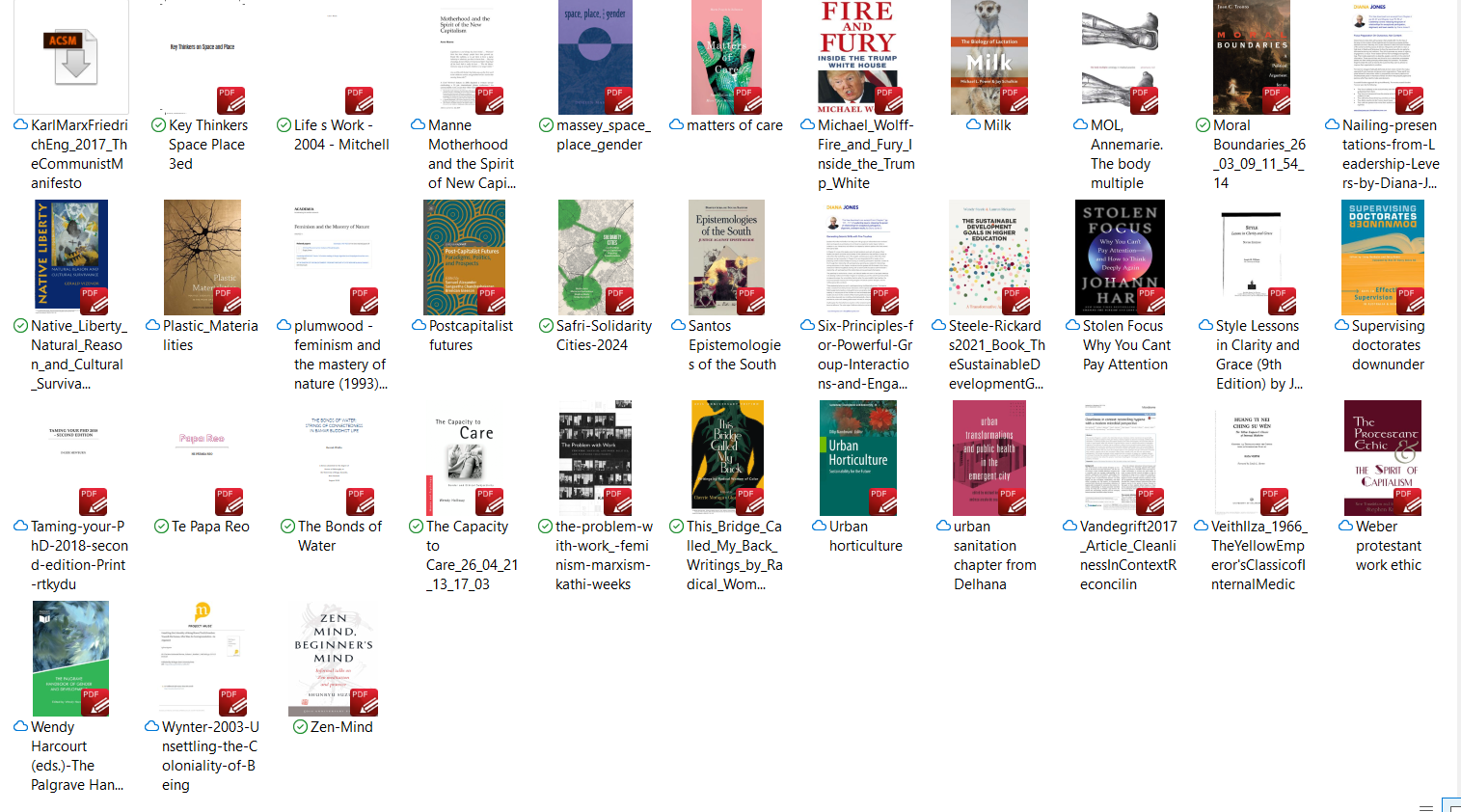
3. Then the actual reading. After my morning workout or meditation, I light my oil burner, and open up the file that I’m writing. Then I read over the last few paragraphs and my notes from my last session. Usually at the end of a session I’ve written instructions to myself for the next session. I might have written something like: “Use the solidarity city work here to make this point”. If I know the point I want to make, I might write it immediately. But if its a bit vague and I haven’t actually read the solidarity city work but I know it will help, I will then dive into 30 minutes of reading. Thirty minutes for me is usually enough to read the introduction to a book, a chapter of a book, or to read the bulk of an article. I then do 30 minutes of writing, while the reading is fresh, using the work I have just read and other things I’ve already read to help me think. And that might be all the reading I do that day, as my son will then be awake and it is time to get the kids ready for school and the rest of the day is full of other tasks and meetings.
But I might also find a second period of reading, in the afternoon when I’ve sorted out all the urgent emails, given my students their feedback, and I’m a bit low on energy and I’m sick of sitting or standing at my desk. I’ll then get a hard copy book and sit on my office couch and read, usually with a pencil to underline if I own the book, or sticky small post its if it’s a library book. Here, I’m reading partly for enjoyment, partly for work. I might also read some of my printed articles at this time, using a highlighter to interact with them. Sometimes I’ll do this even when I do have student work to read — because reading student work requires focus to see what needs to happen and give feedback, while reading completed work of professionals requires less energy and focus.
Finally, I might also do a day of targeted reading in preparation for starting a new section. This will involve getting through about 6-10 books and articles through a mixture of keyword or key author searching in pdfs, browsing tables of contents, reading sections such as introductions and conclusions, and highlighting or copying key quotes that might be useful to come back to. I write notes on these, and do have a onenote notebook for my current book at least. But I don’t always write notes either as it takes time! Sometimes I just have all the things open that I’ve looked at the day before and be reading and writing simultaneously.
Final thoughts
As you can see, my method involves a bit of chaos. It might be disappointing to you that I don’t have a stable system you can set up. But for me, the chaos is part of what enables me to get on with it. Not having a fixed system protects me from feeling like I have to ‘complete’ each piece of reading and produce a certain kind of note before I can move on, or that I have to finish every book even if it is repetitive and not useful. So it is productive chaos! I have tried to pull out some key principles for you, though:
- Start where you are and with who you know. This is a way of making the task less overwhelming. We all come from somewhere and that is our base for reading and knowing in academic work. If you are in geography, start with geography. Don’t rush off into psychology or economics until you need to. If you are a student, start with your supervisor’s work or what they have suggested to you.
- Find your anchor texts. These are the texts you are primarily in conversation with in your writing and thinking. They might change for each project, or they might be fairly consistent over your career. Tim Jackson seems to bring everything back to Hannah Arendt at some point. Avril Bell seems to bring everything back to Levinas at some point. I bring everything back to JK Gibson-Graham. But in different projects, you might engage with key texts — my first book included deep engagement with about 6 key books, most of which I’ve never gone back to. The point of an anchor text is to anchor you somewhere in the morass of academic writing — either for a particular project, or for life.
- Read widely on your topic areas. It’s still important to read widely in the area you are intervening in, but you might read differently. To go back to my opening quip about reading 20 books in a week, we are on day 3 of the week and I have ‘read’ around 8. With a mixture of audio books while walking, searching keywords in pdf books, and skim reading chapters that seem significant after browsing tables of contents, I have managed to get a picture of the topic area that I will start writing on this morning.
- Don’t be a perfectionist. There is no perfect system of reading and note-taking, and if there were, that would probably be a procrastination technique from the actual job which is thinking and writing!
Well, good luck with your reading. I hope my little chaotic intervention is more helpful than not…!


Leave a Reply