
Review of A Different Kind of Power: A memoir Audible Audiobook – Unabridged. Jacinda Ardern (Author, Narrator), Penguin Random House New Zealand Audio (Publisher).
A notification popped up on my phone as I was pulling on my sneakers and directing my kids to their chores, as I prepared to leave them home to go for my twice weekly walk by the Manawatū river. A different kind of power by Jacinda Ardern is now available for loan. I had been waiting a few weeks for the audio version – mainly because I had seen some Instagram clips of Ardern recording her audiobook in studio and I’d saved it in my audio book reserve list via the library app. I immediately downloaded it to start listening on my walk, although my enthusiasm had waned since I had reserved it. Since then, I had read two fairly critical reviews that the book skimmed over important issues, although given both were by middle-aged men, I figured I would still work it out for myself.
Who is the book for?
As a writer, I full well knew the back and forth between editors, publishers and authors – and how the book as it was published was never quite the book you intended to write (or indeed, had written). I was aware that Ardern had been at Harvard while writing the book, and I had even heard snippets of some of the speeches she had given there, at Yale and other universities around the US. Yes, on Instagram. So, I knew that the book was likely written for leadership types in the US, most likely with an eye to Oprah’s book club. Still, it felt a bit jarring to hear the words ‘second grade’ and ‘candy’, as I huffed my way through morning mist and wet grass in the wet winter of Palmerston North.
It felt even more jarring when the Pākehā mangle of ‘Kaing-GAH-roa’ (Kaingaroa) was mentioned multiple times alongside the more correct te reo pronunciation of Murupara, as Ardern narrated her reflections on her childhood in small town New Zealand (with some telling overexplaining of Aotearoa history and economy). We’re not the audience, I thought, somewhat disappointed, despite having told myself this before listening – otherwise she would have got a language coach. I’m not the audience, despite being Ardern’s age, a small-town Pākehā girl sharing many of the same early life experiences – poverty and inequality in a racist town, my family struggling to fit in as newcomers, fish and chip shop and pamphlet run jobs, teen friend’s suicides, debate team. I too had grown up to be an over responsible mum-worker with a stay-at-home husband managing baby feeds.
Writing the book you want?
But writing a book is hard. And writing a book for an American audience especially hard, as their publishers protect them from ever having to translate for themselves terms that the rest of the world regularly copes with when watching or reading US media. And the US media has a particular story they want to hear from Ardern, I knew from personal experience. Well, the US Left anyway. Early in the pandemic, I collaborated on an article for the US journal Rethinking Marxism that mentioned iwi-led checkpoints and lockdowns in NZ. The editors – presumably Marxists – wanted me to reflect more on Ardern’s leadership style and what made people willing to submit themselves to her. I had pushed back, explaining how the government in many ways had responded to demands for closing the country, and how the decisions about what to do were made by cabinet, not Ardern alone. I could well imagine the back and forth between Ardern and her publishers or editors – wanting the individual story of power, not the collective.
I went through the book, on regular walks, listening on the bus on the way to work, listening in the evenings as I did the dishes, cooked for the kids, or crocheted by the fire as my husband took his turn. I started to see the book as something bigger – not a memoir for me, not a memoir for Jacinda Ardern, but a memoir written to do something in the world. But what? Was it for my teen daughters, who might write a speech or project on Ardern and want to read about empathy, compassion, being a hugger and a crier, but also getting shit done? I could well imagine them as an audience – the struggles with reconciling fertility treatment, pregnancy nausea, breastfeeding and work were given with just enough light detail to alert a young person to these difficulties without making them feel insurmountable – just the sort of tone I would take in speaking to the young women I mentored in academia.
Was it a memoir for those young women, thinking about what they might do in the world?
Or, was it written for those who suffer from anxiety and perfectionism, many of whom I’d met in the university – young people who conscientiously over-prepared for everything so as to never let anyone down? Or even for women my age – taking on more and more responsibility out of a sense of obligation and care, a kind of care-full leadership that was often not exactly chosen but resulted from, as Queen Elizabeth is quoted saying in the book “just getting on with it”? Maybe it was for me?
Re-living the moments
Over the weeks I listened to the book, I found myself reliving my own moments alongside Ardern’s recollections. I recall high-fiving a heavily pregnant PhD student I had just passed with emendations as we heard Ardern’s pregnancy announced, myself just a month or so away from announcing another of my own. The spontaneous high five needed no words – we were joyful in the moment of being mothers getting things done, of our highest political leader getting things done and joining us as a mum too.
I later recalled a moment of despair in late 2018 as I was trying to manage chairing a large international conference around the imminent but unclear due date of my own child – I actually gave myself a ‘talking to’ at the time saying:
“If Jacinda Ardern can have a baby and run the country, I can bloody well run a conference.”
I recalled frantically calling one of my Muslim PhD students on March 15, 2019 in Christchurch, who had just left a meeting with me in time for afternoon prayer. Then my daughter, who was sheltering in place in shop in central Christchurch after the police had broken up the climate march, unsure of who exactly this shooter on the loose might target. Then my husband, who was standing outside our children’s school with mums in hijab, unknowing as to why the children had not been released from class (and would not be until the evening).
I recalled my disappointment as my elderly relatives travelled to Wellington to camp outside parliament, sharing ‘Nuremberg 2.0’ misinformation directed at Ardern on our family chat, as well as indignation at Trevor Mallard’s Baby shark broadcast.
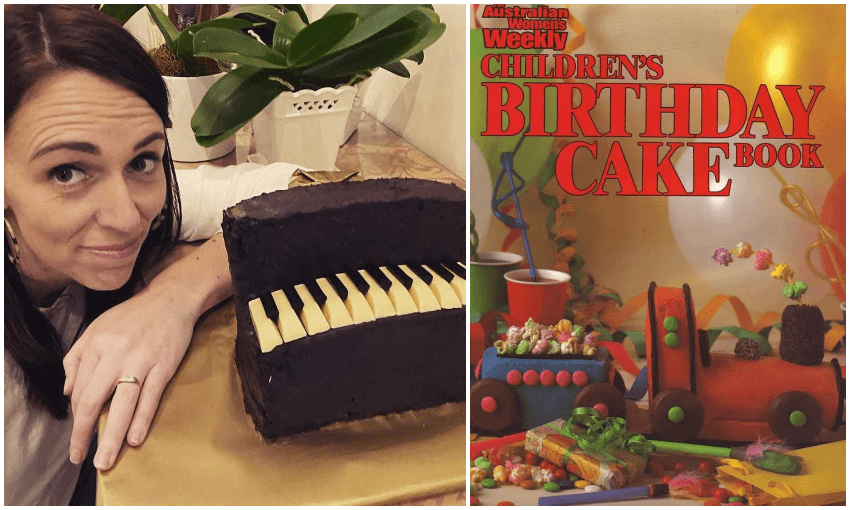
Weirdly, even Ardern’s personal moments seemed recognisable – her birthday cakes from Australian Women’s Weekly had circulated on Instagram and Twitter, around the time I was choosing birthday cakes for my youngest. Engagement announcement, and then of course, all the international moments and iconic photos that circulated the world.
The book, it seemed, was a fleshed-out Instagram feed – the highlights probably accumulated by an editor and featuring the iconic images of pregnant Ardern in her mustard gown and kakahu striding toward the queen. The new family outside the hospital introducing Neve Te Aroha to the world. Ardern making faces at Neve and Clarke in the UN assembly, Ardern in a borrowed black headscarf sorrowfully listening to Muslims in Christchurch recounting events of the mosque attacks.
In each of these, Ardern recounts what she was feeling and thinking at the times of the images. I almost wonder if the method for writing the book was an American editor holding up iconic images, asking Ardern to reflect on what was happening (insides felt like they were falling out after having a baby, thinking about the leadership of the imam of Al-Noor Mosque rather than her own leadership, the Queen’s ‘just get on with it’). It is as good a method as any to structure a book. My first significant piece of long writing, my supervisor basically gave me the chapter titles and I went to it.
But, as other reviewers have said, sometimes you are left wanting a bit more. The series of iconic moments are a bit too iconic. The grit of policy writing and debating are also there, and the moments of decision. But all in all, the book is clearly a book about mothers in work – it opens with a pregnancy test, and it finishes with conversations with her daughter Neve.
The subplots and synchrony
There are other small subplots the structure points to – and this is either Ardern’s skill as a speechwriter, or the editorial help mentioned in the acknowledgements. There are satisfying synchronies in the book: Walter, the Mormon boy who loved perfume/ Walter, the glamorous queen seeing Ardern on the street. Cat Steven’s Peace Train moving young Jacinda to tears / Yusuf Islam performing live the same song at the memorial service in Christchurch. Ardern’s mum struggling with the expectations of motherhood and mental health in small town NZ / Ardern struggling with the expectations of prime-ministership and motherhood in premier house.
Each of these subplots are subplots of compassion, empathy, struggle – seeking to say something about how one’s life is shaped by events but also how one’s life is shaped by how one is able to respond to events. There is always others present, and Ardern is rarely alone. In the same way, our image of a leader is always shaped by events and by others, and we rarely form that alone.
So, who is the book for? I think we have to think both to the context of how it was written – on a fellowship at a prestigious American university – and who would be likely to read it. For me, the book is an oblique message to Americans in a time of American turmoil in leadership.
Telling stories to teach
The book is a bit like the stories about other people that my mum tells me in order to obliquely advise me without seeming to advise me as to what I should do. If my mum told me this story, of an anxious small-town girl becoming a leader without giving up empathy, I would not take the story as the only accurate representation of ‘what really happened’ – I would take it as a message.
The message, as we see in the title and the recurring themes of the book, are this: leaders do not have to look like Donald Trump, or, for that matter, Joe Biden. Or even Hillary Clinton. The leadership that America needs could be something quite different. Ardern – and her editorial team, no doubt – are doing what my mum does so well. Telling a story to a particular audience to change their minds and actions in a particular way.
So, I say, good on her. I hope it works – for the sake of Palestine, Ukraine, the people who are not billionaires, the environment, the planet. And for Americans too.
Bio.
Kelly Dombroski is Professor in Geography at Te Kunenga ki Pūrehuroa Massey University. She researches feminist and care approaches to economic change. She grew up in small-town Wairarapa, and has held academic positions in Sydney and Christchurch. She has four children and lives in Palmerston North.

 Throwntogetherness
Leave a comment