I admit, I do read books that are categorised as ‘productivity’ — I’ve even reviewed a few on this site, such as Elizabeth Emen’s Life Admin, Johann Hari’s Stolen Focus and Cal Newport’s Deep Work. But I deeply dislike the word productivity. I don’t read books like this because I want to be a more ‘productive’ person, although that might be a side effect of applying some of what I have learned. For me, it’s about living a meaningful and intentional life. How do I do more of the things I want to do, and do less things of the things that I don’t want to do?
I’ve recently taken a break from blogging to think about what it is I am trying to achieve on this blog, and my research website Researching Postcapitalist Possibilities. Is this something that is worth spending my time on?
One way of deciding whether something is ‘worth spending time on’ is to think about whether it is ‘productive’. This would involve — I guess — assessing whether the websites help boost the profile of my research, whether that is worth the time I put into to updating them, and so on. But the other way to assess if something is worth doing is about whether it is fun, whether it helps connect with others in meaningful ways, and whether it is useful for others as well as myself.
I make most of my life decisions around whether something is meaningful — which for me, means useful for others or helps connect with others, or makes a difference somehow. The stats and emails tell me that this site is doing that meaningful work.
The other thing I have to look at, however, is do I really have time to do all the meaningful things! I usually try to use productivity tools and hacks to make more time to do all the meaningful things. But they only work to a point. You can’t hack your way into more hours in the day! I’m bubbling with ideas for this site, to make it even more helpful and meaningful, but I have to also do a lot of other important and meaningful work. One of the things I find myself doing at this career stage is getting funding for research, partly in order to create jobs for talented researchers who might otherwise be unemployed, and always for researching things that make a difference in the world.
But that funding success creates an additional set of pressures: producing the contracted deliverables! Some of this work is also very meaningful, but sometimes it is about getting the stuff done in order to meet the requirements of a grant. I now feel like I have a relatively efficient worklife, but I do find myself doing much less of the things I enjoy. I don’t want to be productive all the time, but create space to read and think and go down dead ends and come back out, to prepare classes and do a quality job when I teach, and to make sure I get enough moments of joy to balance out the tedious side of the job.
So yes, using productivity tools is useful to help create space to do what you want to do. But rather than becoming an efficient machine with every hour scheduled, we can also use productivity strategies to create space for other things.
My top productivity strategies include:
- Doing one thing at a time if at all possible. The exception to this is zoom meetings in large groups, where I have to do something else at the same time so I don’t talk too much and take up all the space. Getting into focused flow helps manage stress, increase creativity, and helps create joy in the work.
- Using pomodoro to create 25-minute focus periods (doing one thing). I use the app focus booster to help with this. The normal pattern is 25 minutes work, 5 minutes rest, with a 30 minute break every three sessions (if you are so lucky to get that far!).
- Having a daily focus — at the moment I’m working on Marsden Mondays (grant admin — Marsden being the name of one of my grant funds), Teaching Tuesdays (prepping teaching), Writing Wednesdays (putting actual words on screen), Theory Thursdays (taking time to read), Finishing Fridays (getting stuff done that needs to be done that week). Note, this does NOT mean I only do this on those days, it means that when I have gaps between interminable meetings or other deadlines, that is my go-to focus. It also means I set my daily tasks with one or two tasks from that focus.
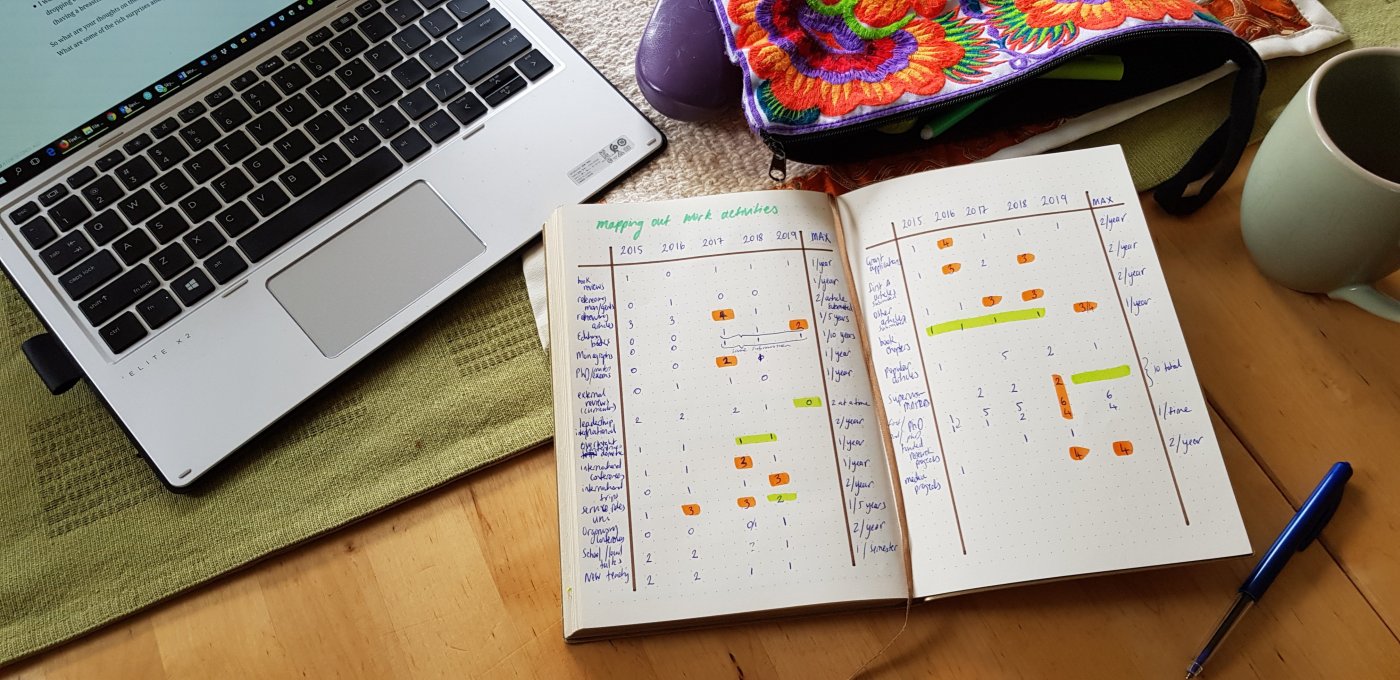
- Setting daily tasks. I use a bullet journal system and take a half hour on Mondays (with coffee and treat) to plan the week, and a few minutes in the morning to review what I need to do for the day and change up the weekly plan as needed. How many tasks can you do in a day? For me it’s usually 3-6 things, plus meetings and meeting prep. I always list meeting prep as a task as well.
- Using a white board to plan out writing and publication, upcoming trips and intense periods. The white board helps keep those things in my consciousness as they are things that might creep up on my unnoticed and create a lot of intense stress, or relatively invisible parts of the job that can easily go undone.
The next series of posts will go into these strategies in a bit more detail — again, not to increase productivity for some faceless institution, but to create space to do what we love and find joy and meaning in the work that we do.
Mauri ora,
Kelly

 Throwntogetherness
Hi Kelly! I’m teaching full-time this year and your email was very timely! A new job and also having to simultaneously learn how to teach structured literacy (micro credential thru CU) is spinning my brain! I do love the idea of doing one thing at a time and I also use a white board – lots of great thoughts in your blog xx
Manaaki te Atua
Margaret
LikeLiked by 2 people
That’s a lot Margaret! Teachers amaze me constantly. I look forward to hearing what works for you. And sometimes, it is just a panicked stumble from one urgent thing to the next and we have to just let that happen when it needs to.
LikeLike